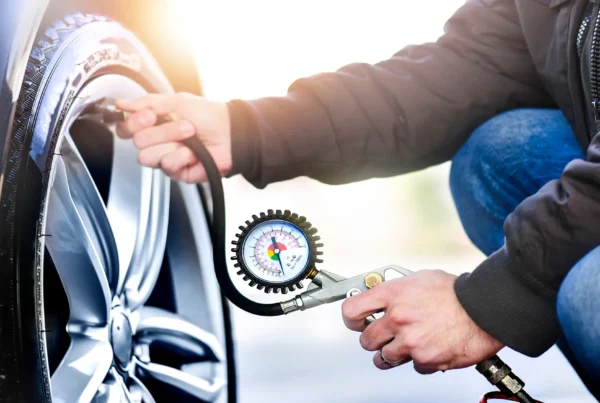

A new tire looks new. Black, full tread, a paper sticker with a price and a model name. None of that tells you how old it is.
Rubber has a birthday, and it is stamped into the sidewall. A tire that rolled off the production line three years ago and then sat in a warehouse is still sold as new, because it is new. It has never carried a car. But it has been aging that whole time, and the clock that matters most to a tire manufacturer started the week it was built, not the day you paid for it.
This post is about that clock. Not sizes, not load ratings, not speed ratings. Just age: where to find it, what it means, and what to ask before you hand over a card. The same four digits work at a tire shop in Oak Forest, at the counter when you are buying tires in Orland Hills, or on a laptop in New Lenox at midnight.
Where the DOT tire date code lives on the sidewall
Every tire sold in the United States carries a Tire Identification Number molded into the rubber. The U.S. Tire Manufacturers Association describes it as a special set of letters and numbers on the sidewall, and it always starts with the letters DOT. What you want is the tail end of that string: the last four digits are the manufacturing date.
- The first two digits are the week of the year. Weeks run 01 through 52, and occasionally 53.
- The last two digits are the year, for any tire built in 2000 or later.
So a tire stamped 2524 was built in the 25th week of 2024, which lands around late June. A tire stamped 3623 was built in the 36th week of 2023, or roughly early September.
Federal rules define those week numbers precisely. Week 01 is the first full calendar week of the year, week 02 is the second, and so on. The regulation’s own example is the code 0109: produced during the first full calendar week of 2009, Sunday, January 4 through Saturday, January 10. You are not getting a season. You are getting a week.
Can’t find the DOT tire date code? Check the other side.
Federal rules require the complete 13-symbol identification number to be permanently molded into one sidewall. One. Not both.
So if you are squinting at the outboard sidewall and see no four-digit date, the tire is not defective and the code is not missing. It is on the inboard face, pointed at the suspension. A technician with the tire off the car reads both sides in seconds.
Tires built before 2000 used a three-digit code. Find one on a trailer or a project car in the garage, and you have found a tire old enough to vote.
Why a tire ages even when nobody drives it
Tread wear is mechanical. You drive, rubber scrubs off, the grooves get shallow. Everybody understands that part, and most advice about getting the most out of your tires is aimed squarely at it.
Aging is chemical, and it happens on a car, in a trunk, or stacked on a rack. The rubber reacts with ozone and the surrounding environment over time, losing flexibility and eventually cracking at the sidewall. Manufacturers build protective compounds into the rubber to slow that reaction down.
Michelin puts it plainly: over time the materials inside a tire can degrade, which may affect durability and performance even if the tire has seen limited use. Limited use. Not heavy use. The reaction does not need your commute.
That is why “these have never been used” is not the reassurance it sounds like. A spare that has ridden under a cargo floor since the vehicle was new has no wear at all, and it is exactly as old as the car.
One warning that surprises people: Pirelli cautions against products meant to shine up a sidewall. Harsh cleaners strip away the substances built in to protect the rubber from ozone, and removing them can degrade the rubber and lead to cracking. The dressing that makes a tire look newer can help it age faster.
How long can a tire sit on the rack?
Here is the honest answer, and it is not the answer most articles on this subject give you: there is no published number.
The industry is unusually direct about this. The U.S. Tire Manufacturers Association states that service and storage conditions vary widely, so accurately predicting the serviceable life of any specific tire on calendar age alone is not possible. Pirelli’s consumer warranty puts it in stronger language: there is no scientific or technical data that establishes a specific tire service life.
Anyone who tells you a tire is “expired” at a precise shelf age is inventing the number. What exists instead is published and more useful.
What is published
- After five years, get a professional inspection at least once a year. Michelin recommends exactly that, and Pirelli advises inspecting with increased frequency after five years of use.
- At ten years from the date of manufacture, take the tire out of service. Michelin recommends replacing tires ten years after their manufacturing date regardless of remaining tread depth or apparent condition, spares included. Pirelli says the same, and adds that the manufacture date is determined by the DOT code and can be confirmed by a tire service professional.
Read that second one again, because the wording is the whole point. Ten years from the date of manufacture. Not ten years from purchase. Not ten years from mounting.
So shelf time is not free. Buy a tire in August 2026 with a code reading 3623 and it is already three years into that ten-year span before it turns a mile on I-80. Genuinely new. Genuinely unused. Also genuinely three years old.
Storage is the variable
Conditions do a lot of the work. Both USTMA and Pirelli describe the same storage environment: cool, dry, well ventilated, away from sunlight and chemicals. Pirelli calls for storage areas of roughly 45 to 75 degrees Fahrenheit, and warns that tires should never sit against heat or ozone sources such as radiators, electric motors, or hot pipes.
A tire that spent two years in a climate-controlled warehouse is not in the same shape as one stacked outside through Chicago summers and January cold snaps. Same date code, different tire.
Four questions to ask any tire shop in Oak Forest before you pay
You do not need to be an expert here. You need four questions, and any reputable shop in the south suburbs will answer them without flinching.
- “Can you show me the DOT date code on the tires you are mounting?” Not the catalog listing. The physical tires coming off the rack for your car.
- “How have these been stored?” Indoors, dry, out of the sun is the answer you want.
- “When does the warranty clock start?” More on this below, because it is not always the day you buy.
- “Will you write the date code on my invoice?” It takes ten seconds and it gives you a record.
Asking these does not make you a difficult customer. It makes you one who knows what to look at.
Buying tires in Orland Hills, or ordering them from your couch
Searching “tire shop near me” and ordering a set online are very different transactions when it comes to age. A local counter lets you see the sidewall before anything gets mounted. A box from a distant warehouse does not, and by the time you can read the code the tires are already in your garage.
If you do order online, read the codes before anyone mounts them, while the tires are still returnable. You can also shop for tires through us and pick them up at a counter where someone will show you the sidewall first.
The warranty detail almost nobody mentions
This is the strongest practical reason to keep your receipt, and it comes straight out of a manufacturer’s warranty document. Pirelli’s limited warranty runs until the tire wears to 2/32 of an inch of remaining tread or six years from the date of purchase, whichever comes first. The date of purchase is the date on your sales invoice. But if that date is not clear on the invoice, the warranty says the date of manufacture will be used instead to determine eligibility.
The manufacture date is always the earlier of the two. If a claim gets judged from the build date rather than the purchase date, you lose whatever time the tire spent sitting on a rack. Terms differ by brand, so read the warranty that comes with your tires. The takeaway is universal: a clear, dated invoice is worth keeping.
Want to know what a set for your vehicle would run before you commit? Ask us for a current quote rather than a number you read somewhere. Prices move, and the only figure worth planning around is the one for your car, this week.
What age looks like on a tire you already own
You can do a useful check in your own driveway with daylight and a few minutes. You are looking for the fingerprints of hardened rubber.
- Fine cracking across the sidewall, sometimes called weather checking or crazing. It looks like a dry riverbed or an old rubber band.
- Cracks at the base of the tread grooves, where flexing concentrates.
- Rubber that feels hard and glassy rather than slightly pliable under a thumbnail.
- A tire that has stopped looking wet-black and reads gray and chalky after a wash.
Illinois law draws a firm line on some of this. Under the state vehicle code, a tire is unsafe if any part of a ply or cord is exposed, if a crack, cut, or snag is deep enough to expose a ply or cord, if there is any bulge, knot, or separation, or if the tread wear indicators are flush with the tread surface. Those are not judgment calls.
When age alone is reason enough for tire age replacement
Tread depth and age are two separate tests, and a tire has to pass both.
In Illinois, the legal floor for tread is a groove depth of 2/32 of an inch, measured in two or more adjacent grooves at three points around the tire. Michelin marks that same depth with molded tread wear indicators.
But that is a wear standard. It says nothing about age. A tire can sail past a tread depth check and still be a decade past its build week, which is what the ten-year guidance exists to catch. This is where tire age replacement stops being theoretical:
- Vehicles that see very few miles a year: classic cars, seasonal trucks, campers, second cars.
- Full-size spares, which manufacturers include in the same ten-year recommendation.
- Trailer tires, which spend most of their lives parked and exposed.
- Any set whose DOT code you cannot account for, because the previous owner is not around to ask.
The USTMA also recommends inspecting all of your tires monthly, spares included, with attention to inflation pressure, tread wear, and damage. That habit costs nothing and catches most problems early.
What this means for Cook and Will County drivers
South suburban roads are hard on rubber that has already stiffened with age. Winter salt, repeated freeze cycles, spring pothole season on the arterials, and summer heat on I-80 and I-55 all ask a tire to flex and recover. Aged rubber flexes worse and recovers slower, and it cracks first at the spots that flex most. The same road salt that goes to work under your car every January splashes across sidewalls that have already lost some of their give.
That matters for the way people around here use their vehicles. A boat trailer parked in Oak Forest nine months a year. A second car in an Orland Hills driveway that runs to the Metra lot and back. A work truck in New Lenox with a spare underneath nobody has looked at since it was delivered. All low mileage, all aging on schedule.
Buying tires in Orland Hills, replacing a set in New Lenox, or just wanting the codes read on what you already have all lead to the same short visit. Bring the car in, and we will read both sidewalls, measure the tread, and tell you honestly whether the set needs replacing now or has real life left.
A new sticker is easy to print. The date is molded into the rubber. Look at the rubber.
Ready to check your tires’ age?
Our team at De’s Tire & Auto can read the DOT tire date code on your current tires, measure your tread, and show you what we are mounting before it goes on your car. Visit us in Oak Forest, Orland Hills, or New Lenox, or request a quote for your vehicle.