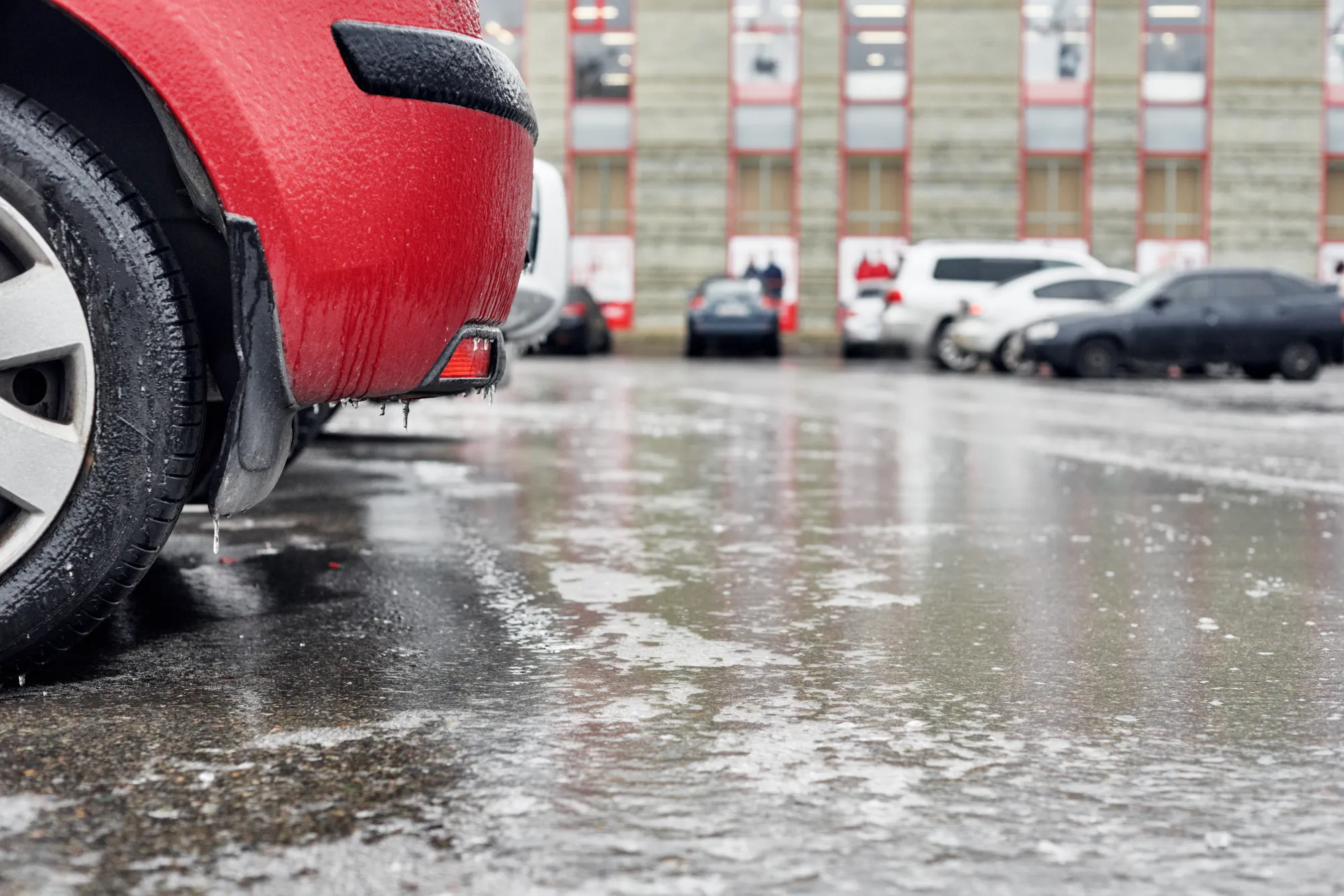
Most drivers start thinking about winter visibility the moment the windshield goes white. By then you are already reacting. The trouble starts a few inches off the glass, out on the pavement, where brine and slush get picked up by every tire ahead of you and thrown back at your car as a fine gray mist. Rain is clean water. Road spray is water plus salt plus grit, and it does not run off. It dries in place as a film.
Seeing through a Cook and Will County winter is not one repair. It is a set of wearing parts working together: blades, washer fluid, headlight lenses, aim, and the defroster elements on both pieces of glass. Commuters heading out of Oak Forest, Orland Hills, and New Lenox all face the same conditions, so here is how each part fails and what to look for.
Why Salt Spray Is Harder on Your Windshield Than Rain
Rain gives you droplets, and droplets wipe away in one pass. Salt slush gives you fine mineral particles, and when the water in it evaporates off warm glass the minerals stay behind as a haze that scatters every oncoming headlight into a starburst.
We have written before about what road salt season does under your car. The same brine that goes after your brake lines is landing on your windshield. The Illinois Department of Transportation has reported spreading more than 437,100 tons of salt statewide in a recent winter, with over 1,800 trucks covering more than 17,000 centerline miles of road. Every one of those miles turns into spray the moment traffic starts moving.
The season is longer than most people plan for. According to National Weather Service climatology for the Chicago area, measurable snow of a tenth of an inch or more normally begins around November 18 and runs until about April 2, snowfalls of an inch or more typically start around December 7 and continue to roughly March 20, and Chicago’s normal seasonal snowfall is 38.4 inches. That is four and a half months of salt water on your glass, not the two or three weeks of “real winter” people picture.
IDOT also warns that a road may appear clear and still be treacherous with black ice, and it advises slowing down and increasing the distance between vehicles. Both of those decisions depend on seeing far enough ahead to make them.
Winter Windshield Wipers in the South Suburbs: What Actually Wears Out
A wiper blade is a rubber edge held at a specific angle and pressure against curved glass. Everything that goes wrong with it is a loss of edge, angle, or pressure, and Chicago-area winters attack all three.
The four ways a blade quits
AAA describes four wear patterns, and it helps to know which one you have:
- Wearing. The square rubber edges become rounded from heavy use, so the edge pushes the water film instead of cutting it.
- Splitting. Ultraviolet rays penetrate the rubber squeegee, breaking it down and separating it from the blade frame.
- Streaking. The rubber dries, hardens, and cracks, leaving lines of unwiped water in your line of sight.
- Skipping. A blade that has sat unused develops a curvature and chatters across the glass.
Two of those come from use and two come from sitting still. The set on your car has been baking through a south suburbs summer, and the first hard slush storm on I-80 is where you find out which one you have.
How often to replace them
AAA’s general rule is every six months or 6,000 miles. Rain-X puts it at every six months to a year, or as soon as you notice a difference in driving visibility, and it names moisture including saltwater and airborne debris such as sand, mud, and dust among the causes of blade deterioration.
If your blades went on in spring, they are due. That is why winter windshield wipers are a fall errand for south suburbs drivers rather than a January emergency.
Why blade construction matters more on salted roads
The old-style blade uses an exposed metal frame with several hinged joints. Those joints are where wet snow packs in, refreezes solid, and stops the blade from flexing to the curve of your windshield. You get a rigid arc and a smeared wedge at both ends.
Beam-style blades take the frame out of the equation. Bosch describes its beam blades as a patented beam design with an aerodynamic spoiler, using precision-tensioned dual steel springs that apply uniform pressure along the entire blade length, and it rates its Snow Driver blade as tested to perform at 20 degrees below zero. Uniform pressure is the whole game in cold weather. A blade that presses evenly clears salt film in one pass, and one that presses unevenly needs three.
Two habits that ruin a set of blades every year
- Never use the wipers to de-ice the windshield. Rain-X says it plainly, and the damage is mechanical: the blade tears itself on frozen ridges. Use a scraper, or let the defroster do the work.
- Pull the blades away from the glass during winter months, as Rain-X recommends, to keep ice off the squeegee and stop the rubber freezing to the windshield overnight.
Washer Fluid Freezing in Chicago: Read the Rating, Not the Label Color
Here is the failure almost every driver in the south suburbs has lived through. It is 15 degrees, a semi throws slush across your windshield on I-80, you pull the washer stalk, and the fluid slushes on contact and smears into a translucent band at eye level. You are driving blind at highway speed with the wipers running.
That is not a pump problem. It is summer-weight washer fluid left in the reservoir into November. A weak mix can freeze in the reservoir, the lines, the pump, or right at the nozzles, and what does reach the glass refreezes on a windshield already below freezing. Washer fluid freezing in Chicago winters is almost always a purchasing decision made back in July.
Buy by the temperature rating printed on the jug rather than by color or price. Prestone, for one, rates its de-icer washer fluid to melt ice and frost down to 34 degrees below zero and says it works to prevent dangerous refreeze. The number on the bottle is the spec.
A few practical points:
- Change over completely, do not just top off. Adding winter fluid to a half tank of summer fluid dilutes the rating you paid for.
- Keep the reservoir full. Winter uses far more fluid than summer, and IDOT lists washer fluid alongside an ice scraper among winter emergency-kit items.
- Watch the spray pattern. A jet that dribbles, sprays sideways, or hits the roof is clogged or misaimed.
- Know whether your vehicle has heated nozzles, because on those the failure is often electrical rather than a fluid choice.
Early Sunsets Are the Part You Cannot Fix With a Scraper
By early December, sunset in the Chicago area lands at roughly 4:20 to 4:25 in the afternoon and holds there for weeks. If you clock out at four, your whole drive home through Oak Forest, Orland Hills, or New Lenox happens in the dark, on roads that are wet, reflective, and in long stretches unlit.
Headlights are not as strong as we assume even when new. AAA’s testing found that the most advanced headlights it tested illuminated just 40 percent of the sight distances full daylight provides, that halogen headlights fail to safely illuminate unlit roadways at speeds as low as 40 miles per hour, and that 50 percent of crashes occur at night.
Now take away most of that light. AAA found clouded or yellowed headlights produce only 20 percent of the light new headlights do, and on low beam just 22 percent. The lenses do not have to look bad to be failing: AAA notes headlights can begin deteriorating as early as three to five years of age. The bulbs light, the beam pattern is there, but on an 11-year-old sedan the light scatters inside a milky lens instead of reaching down the road.
Illinois law ties this to the weather. Under 625 ILCS 5/12-201, lighted headlamps are required from sunset to sunrise, at times when rain, snow, fog, or other atmospheric conditions require the use of windshield wipers, and any time people and vehicles are not clearly discernible at 1,000 feet. Wipers on means lights on.
Headlight restoration in Oak Forest: what it recovers, and what it does not
AAA measured what each path recovers:
- Professional or DIY restoration returned light output to approximately 70 percent of new.
- Aftermarket replacement assemblies restored between 83 and 90 percent.
- Original equipment replacement restored output back to 100 percent.
Restoration is the right first move on many vehicles and the wrong move on a lens that has crazed all the way through. Which path fits your car depends on how deep the oxidation runs, whether the housing has taken on water, and how the assembly comes apart on your model. Those same factors are what drive what the job costs, so rather than guess, ask us for a current quote on headlight restoration or replacement for your vehicle at our Oak Forest, Orland Hills, or New Lenox store.
Aim matters too. A clear lens pointed too low gives you a bright puddle of light and nothing beyond it. Pointed too high, it blinds oncoming traffic and washes out your own view in falling snow.
The Inside of the Glass: Defroster, Fogging, and the Rear Grid
Wet boots and snowy coats load the cabin with moisture. Fogging happens when the humidity inside rises enough that the dew point climbs above the temperature of your windshield, and the moisture condenses on the coldest surface it can find.
Heat alone is slow at fixing that. Drying the air is fast, which is why nearly every modern defrost setting engages the air conditioning compressor even in January. As one clear explanation of the psychrometrics puts it, the reason you want the air conditioner on is that it removes moisture from inside the car, condensing water vapor onto the evaporator coil and draining it away. Run the defroster with the A/C engaged and recirculation off.
That also means a system low on refrigerant takes your defroster with it in winter, not just your cold air in July. If your defrost setting has stopped clearing the glass the way it used to, AC service and repair is where that gets diagnosed.
Two more items on the inside of the car:
- The rear defroster grid. A single broken line leaves a horizontal stripe of frost right where you look when you back out of the driveway. Heated mirrors fail the same quiet way.
- The cabin air filter and blower. A clogged filter starves the defroster of airflow, so the glass clears slowly at the bottom and never at the top.
A Ten-Minute Pre-Winter Visibility Check
Do this in your driveway before the first storm, the same way you would run through a seasonal maintenance checklist:
- Lift each wiper and run a fingertip along the edge. Rounded, split, or cracked means replace, not clean.
- Run the wipers on wet glass and watch for streaking, chatter, or an unwiped wedge at either end.
- Clean the inside of the windshield. Interior film is half of the glare you see at night.
- Check the washer level and confirm the fluid is rated for winter temperatures.
- Fire the washers and watch the spray pattern on both sides.
- Walk around with the lights on: low beams, high beams, turn signals, brake lights, reverse lights, fog lamps.
- Look at the lenses in daylight. Yellow, milky, or crazed is a light-output problem, not a cosmetic one.
- Test the front defroster, the rear grid, and the heated mirrors, and put a scraper in the car.
Get Winter-Ready Vision Before the First Storm
Salt is already stockpiled and the sunsets are already sliding earlier. Blades, washer fluid, lens clarity, aim, and defroster elements are all quick, unglamorous items, and together they decide how much road you can see on a dark, wet drive home through Cook and Will County.
If you are looking for a shop near you to get winter-ready, our team in Oak Forest, Orland Hills, and New Lenox will check your visibility system and tell you plainly what needs attention now and what can wait. Request a quote and we will go over exactly what your vehicle needs before the salt trucks roll.